

Clean Beauty has pushed consumers to read ingredient lists more carefully than ever. But what many brands are beginning to realize is that consumers are also starting to question the packaging itself.
As formulas become “cleaner” and more sensitive, the materials that come into direct contact with those formulas are increasingly under scrutiny.
Clean Beauty Is No Longer Just About Ingredients
Consumer behavior in the cosmetics market is clearly shifting. Buyers are no longer relying solely on claims printed on product labels. Instead, they are examining products more closely from ingredients to the materials used in packaging.
Several market studies point to the same trend. More than 80% of consumers read ingredient labels before purchasing, and around 67% say packaging sustainability influences their buying decisions.
Clean Beauty is therefore no longer defined only by what goes inside the formula, but also by what surrounds and protects it.
Why Cosmetic Pouches Are More Important Than Many Brands Realize
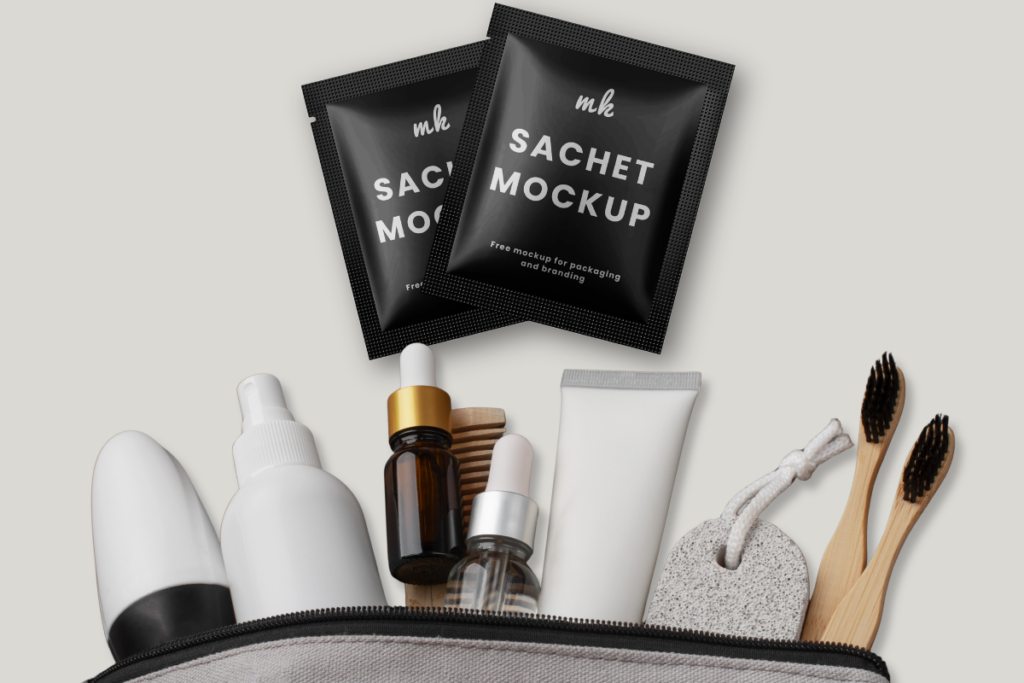
Many cosmetic formulations contain ingredients that are sensitive to environmental conditions. Essential oils, botanical extracts, and certain active ingredients can degrade when exposed to oxygen, moisture, or light.
This means cosmetic pouches do far more than simply hold a product. They must also control external factors that can affect product stability.
Laminated films used in pouch packaging are often engineered with barrier properties, meaning they limit the transmission of oxygen, moisture, and light.
When the barrier structure does not match the formulation, the product may not spoil immediately but its fragrance, color, or texture can deteriorate faster than expected.
Southeast Asia’s Climate Makes Packaging Even More Critical
Climate is a factor many brands underestimate, especially in Southeast Asia where high temperatures and high humidity are present almost year-round.
Heat and moisture can accelerate chemical changes in cosmetic formulas. If packaging cannot sufficiently control oxygen or moisture transmission, the product’s quality may decline faster than anticipated.
This is why manufacturers often need to design film structures tailored to the climate of the target market, not just rely on generic packaging specifications.
Packaging that performs well in one region may not deliver the same results when products are distributed in another.
How Successful Brands Choose Packaging Today
Fast-growing cosmetic brands increasingly share one common practice:
they no longer choose packaging based solely on cost.
Instead, they consider factors such as:
- Whether the film structure is compatible with the formulation
- Whether the barrier properties support the intended shelf life
- Whether the packaging can withstand transportation and climate conditions
As a result, packaging suppliers are no longer simply manufacturers.
They are becoming development partners in the product creation process.
In a highly competitive market, a brand’s advantage does not come only from its formulation. It also comes from the systems behind the product that ensure consistent quality for consumers.
Hoei: A Strategic Partner for Cosmetic Pouch Packaging
In an era where Clean Beauty goes beyond ingredients, packaging decisions are no longer just about cost or aesthetics. They are strategic choices that influence product stability, customer trust, and the long-term reputation of a brand.
Hoei, a manufacturer specializing in cosmetic pouch packaging, provides technical consultation on barrier properties, film structures, and formulation compatibility. This helps brands ensure that their products maintain quality from production to the consumer’s hands whether sold in Thailand or exported to wider Southeast Asian markets.
Q&A
Q1: How are cosmetic pouches different from general packaging pouches?
Cosmetic pouches are designed for formulas that are more sensitive to environmental conditions. Ingredients such as essential oils, botanical extracts, and active compounds require packaging films that can better control oxygen, moisture, and light exposure.
Q2: Why is packaging connected to the Clean Beauty trend?
Clean Beauty consumers are increasingly examining every component of a product. Packaging materials that come into direct contact with formulas are therefore becoming part of a brand’s credibility and transparency.
Q3: Can cosmetic formulas really degrade because of packaging?
Yes. If packaging cannot sufficiently control oxygen, moisture, or light transmission, the product may experience faster changes in fragrance, color, or texture.
Q4: How important is packaging for small or SME cosmetic brands?
Packaging can be even more critical for smaller brands. A single quality issue can quickly damage customer trust, so choosing packaging compatible with the formulation from the start helps reduce long-term risks.
Q5: How can brands determine whether their current pouch is suitable for their formula?
Brands should review technical specifications such as barrier properties, water vapor transmission rate (WVTR), and oxygen transmission rate (OTR), and ideally conduct compatibility testing with the formula before commercial use.
References
International Organization for Standardization (ISO).
ISO 22716:2007 – Cosmetic Good Manufacturing Practices (GMP)
https://www.iso.org/standard/36437.html
ASTM International.
ASTM F1249 – Standard Test Method for Water Vapor Transmission Rate (WVTR) of Plastic Films and Packaging Materials
https://www.astm.org/f1249
World Health Organization (WHO).
Stability Testing Guidelines for Climatic Zone IVb (Hot and Humid Regions)
https://www.who.int/publications
Packaging Europe.
Barrier Films in Flexible Packaging and Product Protection
https://packagingeurope.com
Cosmetics Europe.
Guidelines on Cosmetic Packaging and Product Integrity
https://cosmeticseurope.eu