

Many food brands still choose packaging based on how the pouch looks when the product is placed neatly on a meeting table or displayed on a shelf. If the pouch looks attractive, the colors are accurate, the branding is clear, and the material appears premium, it may feel as though the packaging is ready for use. However, once the product enters real production, one batch may not only be sent to a retail store. It may also be photographed for a marketplace listing, packed into a parcel box, arranged in a gift set, placed in a refrigerator, or opened and reused at the customer’s home.
For this reason, a food packaging pouch today should not be evaluated only by appearance or food grade standards. Sales channels have changed significantly. One product must now perform across many situations at the same time. In retail stores, the pouch must be easy to notice. Online, it must look credible in product photos. During delivery, it must maintain its shape. After opening, it should not reduce the product experience faster than expected.
The principles of Good Hygiene Practices, or GHP, and Hazard Analysis and Critical Control Points, or HACCP, both focus on keeping the food chain safe from the production process to the consumer. This concept shows that packaging is not merely a final decorative element. It is part of a system that helps control product quality and food-related risks.
A Pouch That Looks Good on the Shelf May Not Be Enough for Online Sales
A pouch designed to stand out on a retail shelf may use bold colors, a clear logo, or large product images so that customers can easily pick it up in-store. However, when the same product is sold online, the role of the pouch changes immediately. Customers cannot touch the actual product before buying. They make decisions based on screen images, product details, reviews, and the level of trust the packaging communicates within just a few seconds.
A food packaging pouch that suits multiple sales channels must work both on the shelf and on the screen. If the pouch looks good only when viewed in person, but appears unclear in photos, shows inaccurate colors, or fails to stand apart from other products on an online platform, the brand may lose an opportunity before the customer even clicks to view the product details.
Another point many brands overlook is that online channels make the pouch get judged before the product itself. Customers may not yet know the taste or actual quality of the food, but they often assess credibility from the product image first. Packaging designed only for retail display may therefore be insufficient for products sold through multiple channels at the same time.
Food Packaging Pouches Must Keep the Product in Good Condition Until It Reaches the Customer
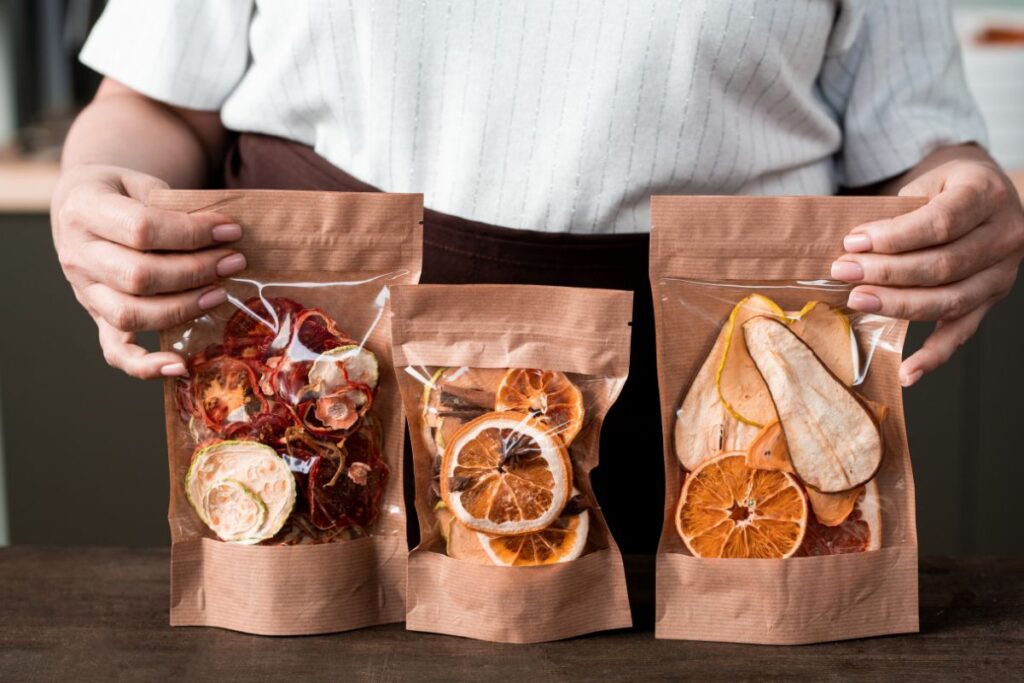
Products sold in-store and products delivered to customers’ homes face different environments. In-store products may mainly deal with handling and shelf arrangement. Online products, however, must withstand pressure inside parcel boxes, vibration during transport, temperature changes along the route, and waiting time at different delivery points before reaching the customer.
If a food packaging pouch cannot handle these conditions, problems may begin with wrinkling, deformation, partial seal opening, or a product that looks unfit for sale when it reaches the customer. The damage does not affect only the pouch. It directly affects the customer’s first impression of the brand when they open the package.
For brands selling through several channels, transportation should be considered from the pouch selection stage, not only after problems occur and the brand has to add more protective materials at the end of the process. When the pouch performs well from the beginning, the brand can reduce product damage, complaints, and repeated costs from delivery issues.
What the Pouch Needs to Withstand
| Situation | Role of the Pouch | Commonly Overlooked Risk |
| Retail store | Shelf display, handling, and competition with other products | The pouch does not stand well, information is hard to read, or the color is not noticeable enough beside competitors |
| Online marketplace | Product photography and screen-based decision-making | The actual pouch looks good, but the online image does not communicate quality or differentiation |
| Home delivery | Pressure, impact, and condition changes during transport | The pouch wrinkles, leaks, or loses shape before reaching the customer |
| Gift set or product bundle | Being displayed together with other products and contributing to the overall package image | The pouch does not match the set or makes the product look less valuable than intended |
| After opening | Opening, pouring, scooping, storing, or reusing | The pouch is hard to open, difficult to store, or causes the product to lose quality faster |
The Right Food Pouch Must Be Safe and Support Real Sales Conditions
Food grade is an essential requirement for food packaging pouches because materials that come into contact with food must be safe and suitable for use. In Thailand, the Thai Food and Drug Administration has the Ministry of Public Health Notification No. 435 B.E. 2565 regarding the quality or standards of plastic containers for food. This provides an important framework for packaging that directly relates to food.
However, in real sales conditions, material safety is only the starting point. One pouch may pass through many situations, from the production line and transportation to retail display, online product photography, and customer use at home. A pouch that is safe for food contact may still not be enough if it does not match the product’s sales format and actual usage.
Food packaging pouches are therefore more complex than simply choosing materials that meet standards. Brands must also consider how well the pouch preserves product quality, whether it can withstand transportation, whether it communicates the right image online, and whether customers still feel that the product meets a proper standard when they receive it.
One Food Pouch Must Work Well From Production to the Customer’s Hands
On the production side, food packaging pouches must work properly with the manufacturing process, including forming, sealing, dimensional consistency, and suitability for each product type. Even small pouch issues, such as unstable sealing, inconsistent materials, or uneven forming, can lead to waste in the production line, longer machine adjustment time, and unnecessary costs.
On the retail side, the pouch does more than contain the product. It must also help the product sell itself. The pouch should be easy to read, clearly present important information, remain in good shape on the shelf, and communicate the brand image at the right product level. If the pouch looks good when it leaves the factory but becomes hard to read, poorly displayed, or not noticeable enough among competitors, it may not be fully doing its job.
For end customers, the pouch must support a smooth user experience. It should be easy to open, convenient to use, suitable for storage after opening, and should not cause the product to lose quality faster than expected. This is why choosing a food packaging pouch should not be based only on appearance or unit price. Brands must consider the full journey the product will pass through before reaching the real user. A good pouch connects production, sales, and the post-purchase experience at every stage.
Cost-Effective Packaging Reduces Repeated Problems Across the Product Journey
The Food and Agriculture Organization of the United Nations, or FAO, notes that packaging plays a role in maintaining freshness, safety, and product shelf life, which is directly connected to reducing food loss and food waste. This matters for food businesses because suitable packaging does not only make the product look good. It also helps reduce damage during storage, transportation, retail display, and real use.
A cost-effective food packaging pouch should not be measured only by unit price. Brands should also consider how much the pouch helps reduce recurring problems, such as product damage, claims, repacking, wrinkled pouches during delivery, or products losing sellable condition too quickly. A pouch that seems economical on the production order date may not be worthwhile if the brand later has to pay more for product loss and problem-solving.
Cost-effective packaging does not need to be the thickest or most expensive pouch. It must be the pouch that properly matches the product’s risks and sales channels. When packaging helps the product move through the factory, retail store, online channel, and customer use with less quality loss, the brand has a better chance of controlling total costs and maintaining long-term product credibility.
Choose Packaging That Matches Selling, Shipping, and Real Use
Food brands that begin with only one sales channel may not notice this issue at first. However, when the product expands into multiple channels, the same pouch may start to fall short. For example, it may work well in retail stores but wrinkle during online delivery. Or it may work well online but become difficult to read when placed on a retail shelf.
Where is the product mainly sold?
Retail stores, online platforms, modern trade, and gift sets all require different packaging conditions.
How does the product travel?
Parcel delivery, stacked boxes, long-distance shipping, and warehouse storage all affect the strength required from the pouch.
Where will customers see the pouch first?
Customers may see the product on a shelf, in an online image, or when opening a parcel box. Each first impression is different.
Does the product need to be stored after opening?
If customers do not finish the product in one use, the pouch should help preserve quality after opening.
Food Packaging Affects Brand Image From the Shelf to the Customer’s Hands
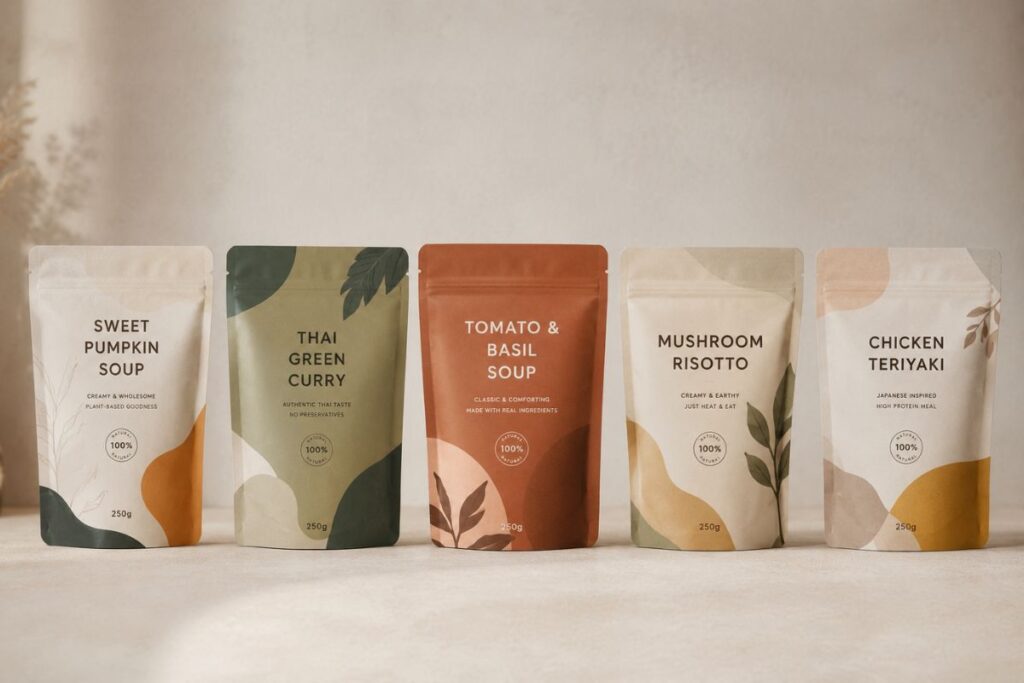
Food products are not judged only when they leave the factory. They are judged repeatedly along the way, from retail display and online images to delivery packaging and real customer use. If a food packaging pouch loses shape easily, wrinkles quickly, or is inconvenient to use, the product image may decline before the customer even tastes the food.
Packaging should therefore not be selected only by looking at the design or sample piece. Brands must consider the journey the product will go through because each channel creates different risks. A good pouch should help the product remain sellable, provide suitable protection, and create a consistent experience whether the product is purchased in-store, online, or through any other channel.
For food brands, one pouch acts as a connection between the factory, sales channels, and end customers. If the pouch can support all these points, the product can maintain a consistent standard across different contexts. If it works only in some situations, the brand may have to repeatedly solve problems related to packing, delivery, product images, and customer experience after receiving the product.
FAQ
How is a food packaging pouch for online sales different from one for retail stores?
A pouch for online sales must place greater importance on product images and transportation because customers cannot touch the real product before purchasing, and the product must pass through multiple delivery stages. For retail stores, the focus is more on shelf display, colors, pouch information, and real in-store handling.
Is food grade enough for packaging sold through multiple channels?
Food grade is the foundation of material safety, but it is not enough for multi-channel sales. The pouch must also handle transportation pressure, retail display, product photography, and use after opening. Brands should consider both food safety and suitability for the product’s actual sales channels.
Why is attractive packaging alone not enough for real use?
Product photos show only certain aspects of the pouch. They do not reveal whether the pouch can withstand transportation, whether the seal is strong enough, whether it stands properly in real display conditions, or whether it is convenient to open and use. Packaging that truly suits the product must perform across production, sales, and end-user experience.
Should brands choose food packaging based on the sales channel or the product type first?
Brands should consider both at the same time. Product type indicates what the pouch needs to protect against, such as moisture, air, odor, light, or pressure. The sales channel indicates what situations the pouch must face before reaching the customer. Looking at only one side often results in packaging that does not fully meet the product’s needs.