

What Are Custom Printed Film Rolls?
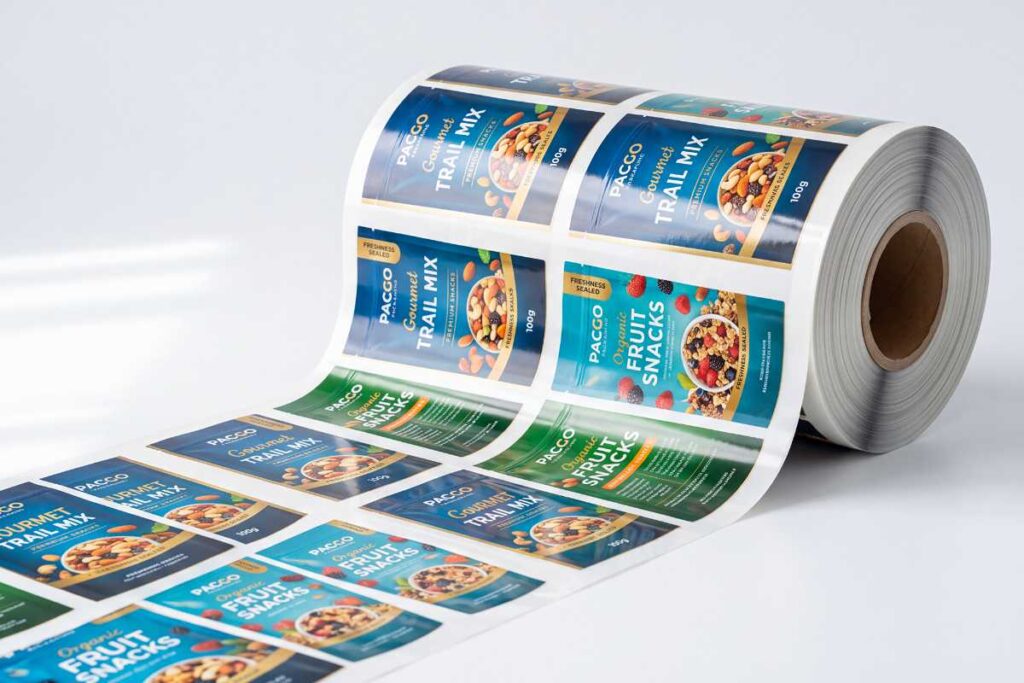
Custom printed film rolls are flexible packaging materials supplied in continuous roll format for use on automated packaging equipment such as form-fill-seal (FFS) machines, horizontal flow wrappers, and vertical packaging machines.
Unlike pre-made pouches or bags, roll film feeds continuously through packaging machinery, where the material is formed into the package, filled, sealed, and cut into individual units. This makes roll stock particularly suitable for brands producing packaged goods at medium to high volumes.
For brands working with PacGo, custom printed film can combine packaging performance with brand communication. HOEI currently provides both digital and gravure printing options through PacGo, allowing the printing method to be matched with production quantity, budget, and design requirements. Important film-roll specifications include:
- Web width: Determined by the packaging machine and finished pack dimensions.
- Film thickness: Selected according to material structure, barrier needs, sealing requirements, and equipment compatibility.
- Roll length and diameter: Matched with machine capacity and desired changeover frequency.
- Core diameter: Must fit the packaging machine’s unwind system.
- Print repeat: Coordinated with the finished package dimensions and cutting position.
These specifications should be confirmed with the packaging equipment requirements before production begins.
Why Does Film Production Quality Matter?
The physical properties of roll film directly affect both packaging performance and machine stability. Variations in thickness, tension, sealing characteristics, or material structure can lead to tracking problems, inconsistent seals, or difficulties maintaining a stable packaging line.
Consistent Film Supports Stable Production
Film thickness and mechanical properties should remain consistent throughout the roll. When the film behaves predictably, packaging equipment can maintain more stable tracking, tension, forming, and sealing conditions.
For products that require moisture, oxygen, or light protection, the chosen material structure also needs to provide the appropriate barrier performance throughout the expected shelf life.
HOEI describes its flexible-packaging approach as beginning with material-structure selection according to the intended product rather than treating packaging as a one-size-fits-all format.
Print Registration Must Match the Film
Printed artwork needs to remain correctly positioned as the film travels through converting and packaging equipment. Excessive film stretch or unstable tension can affect registration between graphics, sealing areas, registration marks, and cutting positions.
For this reason, print design and film properties should be considered together rather than as separate decisions.
Fewer Interfaces Can Simplify Quality Control
When material selection, printing, lamination, and converting requirements are coordinated through the same packaging development process, investigating issues can be more straightforward.
Instead of evaluating print quality alone, brands can assess how the complete packaging structure performs during filling, sealing, transportation, and storage.
Which Film Materials Are Used for Printed Packaging?
Choosing a film material affects product protection, appearance, sealing performance, and compatibility with the packaging line. There is no single structure suitable for every product.
BOPP for Clarity and Stiffness
Biaxially oriented polypropylene, or BOPP, is widely used in flexible packaging because of its clarity, stiffness, and moisture resistance.
Depending on the structure, it may be suitable for products such as snacks, confectionery, and other dry goods. BOPP can also be combined with other films when additional barrier or sealing properties are required.
PE for Flexibility and Sealing
Polyethylene materials such as LDPE and LLDPE are commonly used where flexibility and heat-sealing performance are important.
PE may be used as a standalone film for certain applications or as the inner sealing layer of a laminated structure. The exact grade and thickness should be selected according to the product, sealing conditions, and packaging equipment.
Multi-Layer Laminates for Greater Protection
Products requiring stronger protection from oxygen, moisture, aroma loss, or light may require laminated packaging that combines multiple materials. For example, a structure may combine:
- An outer printable film
- A barrier layer
- An inner food-contact and sealing layer
HOEI’s current flexible-packaging range uses laminated structures across several pouch and packaging formats, reflecting how individual materials can be combined according to the product’s functional requirements.
The appropriate laminate should be based on shelf-life targets, product composition, storage environment, distribution conditions, filling method, and regulatory requirements.
How Can Custom Printed Film Support Branding?
The role of printed packaging extends beyond placing a logo on the product. Film design must communicate clearly while remaining compatible with the technical structure of the package.
Stronger Shelf Recognition
Custom printing gives brands control over colors, graphics, product information, and visual hierarchy.
The objective is not simply to make the pack more decorative. Effective packaging should help shoppers quickly understand the brand, product type, flavor or variant, and other important information. HOEI’s discussion of color psychology in food packaging similarly emphasizes that packaging design needs to communicate clearly rather than rely on appearance alone.
Integrated Product Information
Printed roll film can incorporate information such as:
- Ingredients
- Nutritional information
- Preparation instructions
- Product variants
- Multilingual content
- Barcodes and QR codes
- Required regulatory information
Variable production information such as dates, batch numbers, or traceability codes is usually applied separately using suitable coding equipment during packing.
Greater Design Flexibility
Different printing technologies allow brands to choose between short-run flexibility and large-volume consistency.
PacGo currently positions digital printing for smaller quantities, product launches, market testing, multiple SKUs, and designs that may change frequently. Gravure printing is positioned for larger production volumes where consistent color and detailed print quality are priorities.
What Should Be Checked for FFS Machine Compatibility?
A technically suitable film can still create production problems if its dimensions or mechanical characteristics do not match the packaging machine.
Before ordering custom roll stock, confirm:
| Specification | What to Confirm | Why It Matters |
| Web width | Required machine width and finished package size | Keeps the film correctly positioned |
| Core diameter | Machine spindle specification | Ensures the roll can be mounted |
| Maximum roll diameter | Machine clearance and unwind capacity | Prevents loading problems |
| Film thickness | Equipment and forming requirements | Affects tracking and package formation |
| Seal layer | Sealing temperature and dwell conditions | Supports consistent package closure |
| Print repeat | Package length and cutting position | Keeps artwork aligned with the finished pack |
| Unwind direction | Artwork orientation and machine configuration | Prevents reversed or misplaced printing |
Brands should provide the packaging supplier with information about the machine, finished pack size, product, filling conditions, and sealing method before the film structure is finalized.
This becomes particularly important when transitioning from a pre-made package such as a stand up pouch with zipper to roll-fed packaging, because the forming and sealing stages move onto the brand’s own packaging line.
Which Printing Method Is Best for Flexible Packaging Film?
Digital and gravure printing serve different production needs. The right option depends mainly on volume, artwork requirements, number of SKUs, expected design changes, and cost structure.
Digital Printing for Flexible Runs
Digital printing does not require conventional printing cylinders, making it particularly useful for smaller production quantities and designs that change frequently.
According to PacGo, its digital printing service is intended for applications such as new product launches, market testing, multiple SKUs, and on-demand production.
Digital printing may be suitable when:
- Order quantities are relatively small.
- Artwork may change frequently.
- Several SKUs are being tested.
- A brand wants to avoid holding large packaging inventories.
- Product information changes regularly.
Gravure Printing for Larger Production Volumes
Gravure printing uses engraved cylinders to transfer ink onto the film. It is commonly selected for larger flexible-packaging runs where repeatable color and detailed graphics are important.
PacGo describes gravure as the higher-volume option, with stronger consistency across production runs but higher initial setup requirements because printing cylinders are needed.
Gravure may be suitable when:
- Production volumes are high.
- The design will remain in use for an extended period.
- Color consistency is particularly important.
- Detailed graphics or gradients are required.
- The initial cylinder investment can be distributed across a larger order.
Digital vs. Gravure at a Glance
| Consideration | Digital Printing | Gravure Printing |
| Smaller production runs | More suitable | Less suitable |
| Printing cylinders | Not required | Required |
| Artwork changes | Easier | Requires new or modified cylinders |
| Multiple SKUs | Highly flexible | Better for stable, higher-volume SKUs |
| High-volume unit economics | Less favorable | Generally more favorable |
| Long-run color consistency | Good, depending on process | Particularly suitable |
The best printing technology should therefore be selected according to the commercial life of the packaging, not simply the appearance of a first print sample.
How Should Brands Think About MOQ and Packaging Costs?
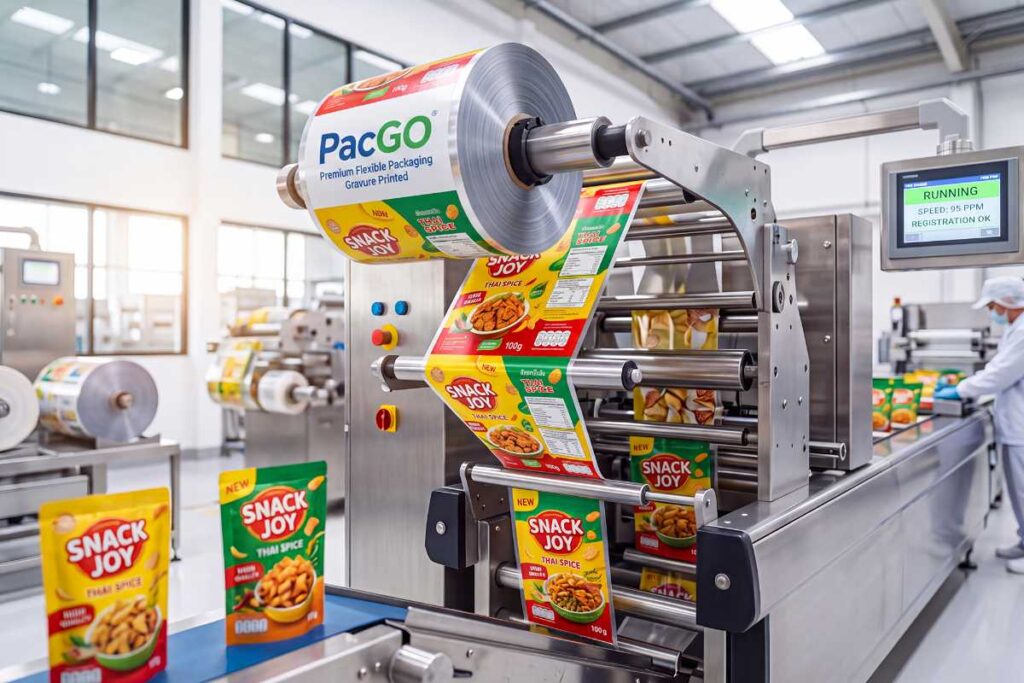
Custom film costs depend on more than the amount of material ordered. Printing method, laminate structure, number of colors, roll dimensions, artwork complexity, and production volume all influence the final economics.
PacGo’s current service addresses this by offering digital printing for lower-volume applications alongside gravure printing for larger production requirements.
Brands comparing suppliers should therefore look beyond a single unit price and consider:
- Expected packaging consumption
- Number of product SKUs
- Frequency of artwork changes
- Inventory that must be stored
- Setup or cylinder costs
- Potential obsolete packaging after a design change
- Compatibility with existing packaging equipment
For a growing brand, ordering a large quantity solely to obtain a lower unit price can create unnecessary inventory if the design, formulation, or regulatory information changes.
Brands considering several package formats can also review HOEI’s flexible laminated packaging options before deciding whether roll stock or a pre-made pouch better fits the production process.
Conclusion
Choosing custom printed film rolls requires us to consider the product, packaging machine, material structure, print method, expected order volume, and future artwork changes together rather than making each decision separately. At Hoei (Thailand), we believe packaging should be specified around the way a product will actually be produced, stored, transported, and sold. For brands deciding between roll stock and pre-made formats such as a stand up pouch with zipper, the most suitable option is the one that balances production efficiency, product protection, and realistic order volumes.
FAQ
What Is the Typical Lead Time for Custom Printed Film Rolls?
Lead time depends on the printing method, laminate structure, artwork approval, production volume, and supplier capacity.
Digital printing generally involves fewer prepress steps because conventional gravure cylinders are not required, while gravure production requires cylinder preparation before printing can begin. Brands should confirm the actual production schedule for their specification rather than relying on a standard industry lead time.
Are Low-MOQ Options Available for New Brand Launches?
Yes. Lower-volume printing can be available, particularly through digital printing.
PacGo specifically positions digital packaging printing for smaller orders, product launches, market testing, and businesses that do not want to maintain large packaging inventories. The minimum practical quantity will still depend on package type, dimensions, materials, and printing requirements.
Can Custom Printed Film Rolls Be Used With Existing FFS Equipment?
Yes, provided the film has been specified for the machine. Web width, core diameter, maximum roll diameter, thickness, sealing characteristics, print repeat, unwind direction, and material stiffness should all be checked before production.
What Artwork Is Needed for Custom Film Printing?
Packaging suppliers generally require production-ready artwork that preserves vector graphics, fonts, image resolution, dimensions, dielines, and color information.
Exact file requirements vary according to the supplier and printing technology, so the printer’s prepress specifications should be confirmed before final artwork is submitted.
Does Custom Printing Affect Product Shelf Life?
Printing alone does not determine product shelf life. Shelf-life protection depends primarily on the complete packaging structure, including barrier materials, seals, laminate quality, product characteristics, filling conditions, and storage environment.
The printing system must nevertheless be suitable for the selected packaging structure and intended application so that inks, adhesives, and other components perform correctly throughout production and use.