

Packaging selection is often viewed as the final step of the production process. Its role is usually limited to containing food neatly, facilitating transportation, and keeping costs reasonable. However, in today’s food business landscape, which faces increasing uncertainty in energy, logistics, consumer behavior, and food safety expectations, packaging has become a core component of a company’s survival structure.
To prevent factors that cause food quality degradation, Hoei foil pouches are designed with multiple material layers that function as protective barriers against risks beyond direct control. These risks include transportation delays, unstable temperatures during transit, and inventory or customs hold-ups. This design aligns with the concept of a Resilience Business and helps reduce business shocks in an era of volatile energy costs and fragile supply chains. In this sense, packaging becomes a form of structural protection for the business itself.
The Role of Hoei Foil Pouches in Strengthening Business Resilience
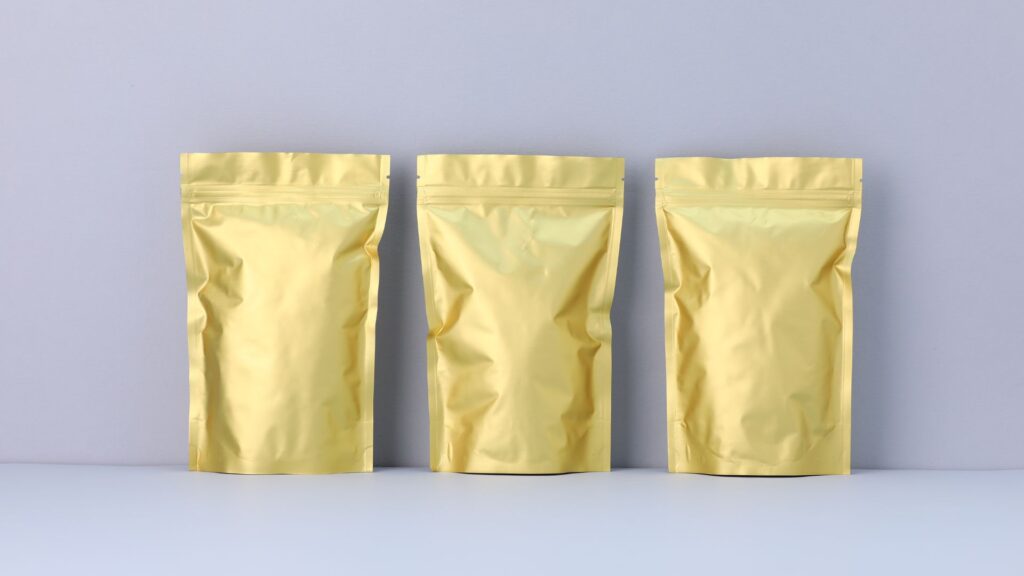
The concept of a Resilience Business is based on a key assumption. If something goes wrong, how much damage will the business suffer, and can it continue operating. Therefore, designing systems that anticipate failure is as important as planning for success. One of the earliest points where food businesses can build flexibility is by choosing packaging that does more than simply serve as a container.
From a resilience perspective, foil pouches are not merely packaging. They act as risk-mitigation structures that travel with the product throughout every stage of the supply chain, especially in environments where surrounding systems cannot operate perfectly at all times. This can be explained as follows.
1. Reducing Risks from Uncontrollable Environmental Conditions During Transit
Many food products do not deteriorate due to production issues, but rather from storage and transportation factors such as air, humidity, or direct exposure to light.
Foil pouches isolate these factors from the system from the very beginning. As a result, food quality no longer depends primarily on transit conditions. Even if transportation is delayed, storage facilities are suboptimal, or products are handled multiple times, the risk of quality degradation is confined within predictable limits. From a resilience standpoint, this effectively locks in product quality and prevents external uncertainty from dictating outcomes.
2. Reducing Dependence on Fragile, Failure-Prone Systems
Temperature control systems, cold storage, and specialized warehousing rely heavily on continuous energy supply, equipment, and personnel. When any one of these elements fails, damage can occur immediately.
Foil pouches reduce reliance on such systems in terms of quality preservation by functioning as a passive protection system. They require no energy, no active control, and they do not fail in tandem with other systems when errors occur. This design reduces weak points in the food supply chain and simplifies overall risk management. It shifts operations from systems that must be perfect at all times to systems that can still function despite occasional deviations.
3. Increasing Flexibility in Distribution and Response to Uncertainty
Food products stabilized by robust packaging can be distributed across a wider range of contexts. Examples include areas with inadequate storage infrastructure, temporary distribution points, or situations where logistics do not proceed as planned.
How to Apply Hoei Foil pouches in Line with the Resilience Business Concept to Strengthen Business Structure
This flexibility is critical to the Resilience Business concept because it prevents businesses from being overly constrained by physical conditions or infrastructure limitations. It also enables faster adaptation to changing situations.
Foil pouches therefore do more than preserve food quality. They open up strategic options that allow businesses to move and respond effectively in an increasingly unpredictable world.
1. Choose Foil Pouches That Truly Fit the Application
Using foil pouches can create real advantages from a Resilience Business perspective only when they are viewed as part of the overall system, not merely as the final component of production. The process should begin with a structured risk analysis that covers production, storage, and distribution. Based on these risks, the appropriate foil pouches structure can then be selected to align with real operational conditions.
1.1 Air- and Moisture-Barrier Foil Pouches
These bags use a foil layer as the core structure, focusing on strong barriers against oxygen and moisture. They help reduce the risk of rancidity, odor changes, and quality deterioration before the expiration date.
Suitable for businesses that
- Have long product shelf lives
- Use multi-stage transportation
- Require consistent quality despite fluctuating environments
1.2 Light-Barrier foil pouches
These bags use fully opaque foil to block UV and external light. They reduce the risk of color fading, nutrient degradation, and quality changes. They are suitable for products displayed in retail environments or stored in warehouses where light control is imperfect.
Suitable for businesses that
- Sell products in brightly lit retail spaces
- Store products in warehouses without full light control
- Require consistent quality throughout display periods and shelf life
1.3 Foil pouches for Sterilization and Ambient Storage
These structures are designed to withstand heat and pressure and support commercial sterilization. They provide very high barrier performance, reduce reliance on cold chains, and lower long-term energy costs. They are ideal for ready-to-eat foods and long-distance or international distribution.
Suitable for businesses that
- Produce ready-to-eat foods
- Ship products over long distances or overseas
- Require maximum system stability
1.4 Semi-Barrier Foil Pouches
These bags use thinner foil or partial barrier materials. They still provide a reasonable level of air protection while helping to control costs. They are suitable for products with shorter shelf life and well-controlled logistics.
Suitable for businesses that
- Have short shelf life products
- Can manage logistics systems effectively
2. Design Foil Pouches Usage to Align with the Supply Chain
Another key consideration is aligning foil pouches usage with the overall supply chain. This includes reducing dependence on temperature control systems, increasing distribution flexibility, and preparing for unexpected situations.
When viewed through the Resilience Business framework, using Hoei foil pouches means designing durability into the business from the very beginning, rather than reacting to problems after damage has already occurred.
Hoei Foil Pouches and the Resilience Business Concept as a Safety Net for Business Failure
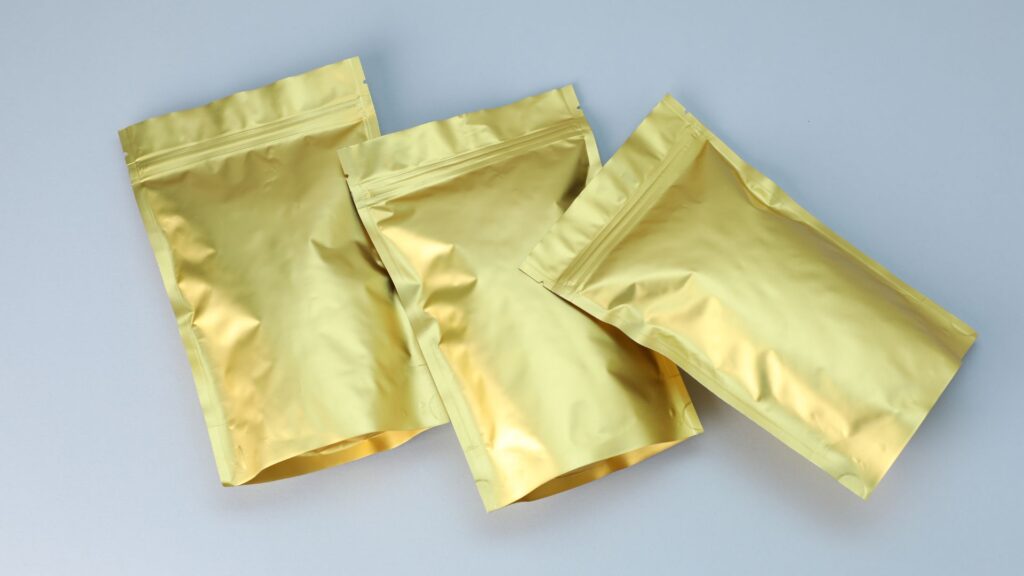
Within the Resilience Business framework, choosing foil pouches is not merely a technical decision. It is a strategic approach to designing a business system that can better cope with uncertainty from the outset. Hoei foil pouches are developed to function as structural protective shields that reduce dependence on external factors and tangibly lower vulnerability within the food supply chain.
When food quality is protected by packaging structure, businesses no longer need to assume that every system will function perfectly at all times. Delays, deviations, or logistical constraints during certain periods do not escalate into uncontrollable damage. This is what allows foil pouches to go beyond basic containment and become packaging that shields product quality from real-world uncertainty.
Strategic use of foil pouches also gives businesses greater decision-making freedom. This includes expanding into new markets, adjusting distribution models, or responding to unexpected future events. The system is no longer locked into a single fragile condition.
In a world where risks do not occur in a linear manner, investing in packaging designed for stability is an investment in business structure rather than an increase in unit cost. This is why Hoei foil pouches should not be viewed merely as food containers, but as one of the key tools that enable food businesses to stand firmly amid the uncertainty that has become a defining feature of the modern era.