

Why Do Retort-Ready Laminated Pouches Matter for Thai Food?
Thai food depends on a careful balance of aromatic herbs, chili heat, rich sauces, and distinctive textures. For manufacturers exporting ready-to-eat products such as green curry, massaman curry, or tom yum, packaging therefore plays a direct role in maintaining product quality throughout storage and distribution.
Retort-ready laminated pouches address this challenge by allowing packaged foods to undergo thermal processing and become shelf-stable without continuous refrigeration. Compared with rigid cans, their thin, flexible profile can also allow heat to reach the product more efficiently during processing. The USDA Food Safety and Inspection Service notes that the flat shape of retort pouches generally allows faster heating than metal cans during commercial sterilization.
For packaging procurement managers, food technologists, and brand owners, selecting a retort pouch requires more than choosing a pouch shape. Material structure, sealing performance, food characteristics, processing conditions, and export requirements must all work together.
What Is a Retort Pouch?
A retort pouch is a flexible, heat-resistant package designed for foods that are sealed and then thermally processed in a pressure vessel known as a retort. A common retort laminate combines several functional layers:
- Outer PET layer: Provides strength, heat resistance, and a printable surface.
- Barrier layer: Often aluminum foil or another suitable high-barrier material that limits oxygen, moisture, and light transmission.
- Inner polypropylene layer: Provides a food-contact surface and supports reliable heat sealing.
The USDA describes the traditional retort pouch as a layered structure using polyester, aluminum foil, and polypropylene. However, the exact laminate should be selected according to the food, thermal process, required shelf life, and intended market rather than treated as a universal specification.
How Does Multi-Layer Lamination Protect Thai Food?
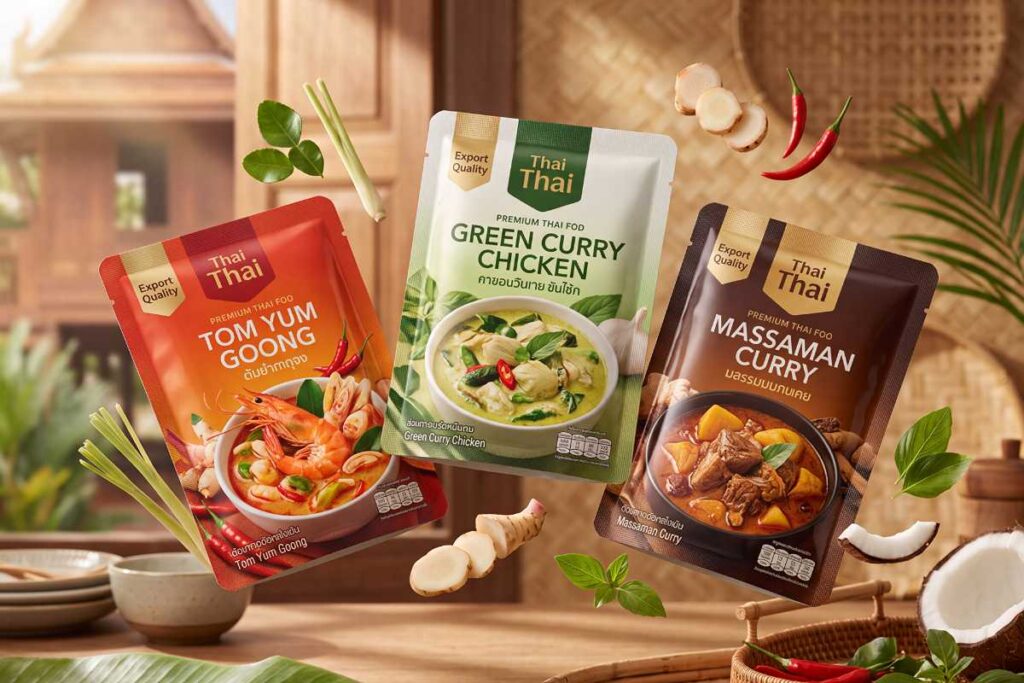
Thai ready-to-eat foods can present several packaging challenges at once. A suitable laminate must withstand processing while continuing to protect the food after it leaves production.
Aromas Need Barrier Protection
Ingredients such as lemongrass, galangal, makrut lime leaves, and basil contribute significantly to the sensory character of Thai food. Exposure to oxygen and light during storage can affect sensitive ingredients and fats. High-barrier laminate structures help limit these external factors throughout the intended shelf life.
Oils and Fats Require Compatible Materials
Many Thai curries and sauces contain coconut milk, oils, or other fat-rich ingredients. Packaging materials therefore need to be evaluated for compatibility with the product rather than selected solely according to appearance or pouch thickness.
The food-contact layer, adhesive system, barrier performance, and seal structure should all suit the actual formulation and processing conditions.
Flexible Pouches Suit Different Food Textures
Thai ready-to-eat products range from thin soups and sauces to thick curries and semi-solid foods. Flexible packaging can be produced in different dimensions and pouch configurations to accommodate these characteristics.
The appropriate format should still be determined according to filling equipment, serving size, product viscosity, thermal process, transportation, and retail requirements.
How Does Retort Sterilization Work?
Retort processing involves filling food into a suitable package, creating a hermetic seal, and thermally processing the sealed product under controlled conditions.
For low-acid shelf-stable foods, commercial sterilization commonly requires temperatures above the boiling point of water. The USDA notes that retort processing often takes place at approximately 240–250°F, or roughly 116–121°C. Exact processing conditions, however, must be established for the specific food, package, fill weight, retort system, and required microbial lethality. A typical process involves:
- Filling the product into the pouch.
- Removing contaminants from the seal area.
- Heat-sealing the pouch.
- Loading sealed pouches into the retort system.
- Heating under controlled temperature and pressure.
- Holding the product according to its validated thermal process.
- Cooling while maintaining appropriate package integrity.
- Inspecting pouches before secondary packing and distribution.
Seal quality is particularly important. FDA guidance identifies seal temperature, pressure, and dwell time as critical factors affecting retort-pouch heat sealing.
The thin profile of a flexible pouch can also shorten heat penetration compared with a conventional metal can, depending on product and package configuration. This can help reduce unnecessary thermal exposure while still achieving the validated process requirement.
What Are the Main Benefits of Retort Pouches for Thai Food Brands?
Lower Packaging Weight and Better Space Use
Flexible pouches generally weigh less and occupy less space than equivalent rigid containers. The USDA identifies both lower weight and compact storage as established advantages of the format.
For Thai food exporters, these characteristics may help improve pallet utilization, warehouse efficiency, and transport planning.
Faster Heat Penetration
Because retort pouches have a relatively thin profile, heat can reach the center of the food more quickly than in many rigid container formats. This can reduce processing time depending on the product and validated retort schedule.
The benefit is not simply speed. Reducing unnecessary heat exposure may also help manufacturers manage product quality during commercial sterilization.
Convenient Handling
Retort pouches can incorporate features such as tear notches and other opening systems. Stand-up configurations can also provide a self-supporting presentation for retail environments. The choice of feature should reflect how consumers are expected to store, open, heat, and consume the product.
Less Dependence on Refrigerated Distribution
When a food and its retort process are properly designed to achieve ambient shelf stability, manufacturers can reduce dependence on continuous refrigeration.
This is particularly relevant for export products or distribution into markets where cold-chain infrastructure adds complexity. HOEI has discussed this relationship in more detail in its guide to reducing cold-chain limitations with retort pouch packaging.
How Should Manufacturers Choose a Retort Laminate Structure?
Not all retort pouches are interchangeable. The structure should be matched with the food and the conditions it will experience.
| Criterion | What to Evaluate | Why It Matters |
| Heat resistance | Compatibility with the validated retort process | Helps prevent deformation or delamination |
| Seal integrity | Seal consistency under processing and distribution conditions | Helps prevent leakage or loss of package integrity |
| Barrier performance | Required oxygen, moisture, and light protection | Supports product quality during shelf life |
| Food-contact compliance | Requirements of the destination market | Supports regulatory compliance |
| Print performance | Compatibility between inks, laminate, and processing conditions | Helps maintain packaging appearance and information |
A conventional PET/aluminum foil/polypropylene laminate is widely used for retort applications, but it should not automatically be specified for every product. Material thicknesses and barrier layers should be selected according to processing temperature, food composition, intended shelf life, and other technical requirements.
Manufacturers dealing with oily, aromatic, or otherwise sensitive products may also benefit from reviewing the broader principles behind choosing laminated pouches for consistent food quality.
What Should Thai Food Brands Look for in a Packaging Partner?
Choosing a packaging supplier should involve both manufacturing capability and an understanding of the food itself.
Lamination and Material Knowledge
The supplier should understand how the laminate structure responds to the intended food, filling conditions, sterilization process, storage environment, and distribution system.
A packaging manufacturer should therefore evaluate more than pouch dimensions and artwork. HOEI’s discussion of why food packaging manufacturers need to understand the product explains how factors such as fat content, moisture, shelf life, storage conditions, and transportation can affect material selection.
Reliable Retort-Compatible Sealing
FDA guidance emphasizes that contamination, grease, moisture, or wrinkles in the seal area can weaken a retort-pouch seal. Manufacturers should therefore discuss sealing temperature, pressure, dwell time, pouch design, and filling conditions with their packaging partner.
Testing should reflect the actual production process rather than relying only on general material specifications.
Export and Food-Contact Documentation
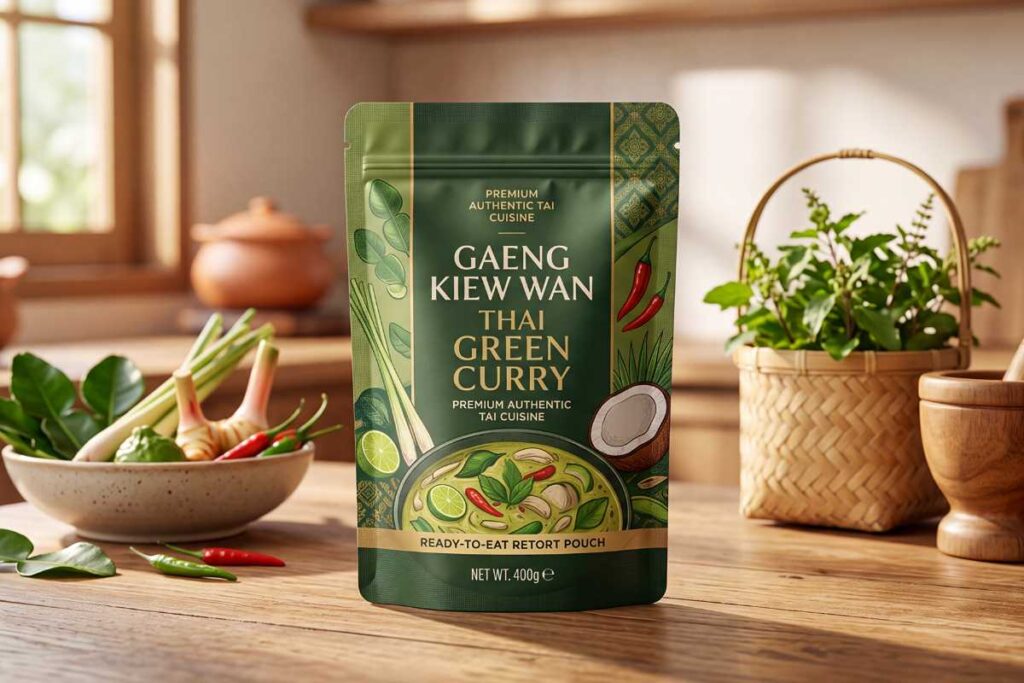
Requirements vary by destination market. Food exporters should confirm what documentation is required for the materials, printing system, food-contact layers, and finished package before commercial production begins.
For products entering the United States, for example, FDA requirements distinguish low-acid and acidified foods partly according to equilibrium pH. Foods with a finished equilibrium pH above 4.6 and water activity above 0.85 are generally considered low-acid foods under the relevant regulations.
A supplier’s ability to provide appropriate material declarations, traceability records, and supporting documentation can therefore be as important as pouch manufacturing itself.
Conclusion
For Thai food manufacturers, selecting suitable packaging means considering the food, thermal process, material structure, sealing conditions, shelf-life requirements, and destination market together. At Hoei (Thailand), we believe these factors should be evaluated before a pouch specification is finalized so that packaging supports the product throughout production and distribution. A properly selected retort pouch should ultimately protect the food under its actual processing and storage conditions rather than simply meet a standard pouch specification.
FAQ
What Foods Are Best Suited to Retort Pouches?
Retort pouches are widely used for thermally processed, shelf-stable products such as ready-to-eat curries, soups, sauces, stews, and similar foods.
Suitability cannot be determined by food category alone. Formulation, pH, water activity, viscosity, particle size, fill weight, package dimensions, and the validated thermal process must also be considered.
How Long Can Food Last in a Retort Pouch?
There is no single shelf-life period that applies to every retort-packed food.
Shelf life depends on the formulation, sterilization process, laminate barrier properties, seal integrity, storage conditions, and product quality targets. Manufacturers should establish shelf life through appropriate product and packaging validation rather than relying on a general pouch lifespan.
Can Retort Pouches Be Microwaved?
Traditional retort pouches containing aluminum foil should not be microwaved.
Microwaveable retort applications require a specifically designed, foil-free structure that has been validated for both the thermal process and microwave use. Manufacturers should confirm the complete material specification rather than assuming any transparent or metalized laminate is microwave-safe.
What Is the Minimum Order Quantity for Custom Retort Pouches?
Minimum order quantities vary considerably according to the manufacturer, pouch size, laminate structure, printing method, artwork, and production process.
Brands should request an MOQ based on their actual specification rather than treating a general industry figure as standard.
Do Retort Pouches Require Special Filling Equipment?
Retort pouches require filling and sealing equipment that can reliably handle the selected flexible package and prevent contamination or wrinkles within the seal area.
Preformed pouches may be filled using suitable straight-line or rotary systems, while form-fill-seal configurations may use different equipment. The final setup should be matched with the product viscosity, pouch format, production volume, and validated sealing requirements.